
“When you realize it is not your responsibility to ‘fix’ or change somebody, you can be open to learning and engaging with people’s differences and not feel a sense of threat.”
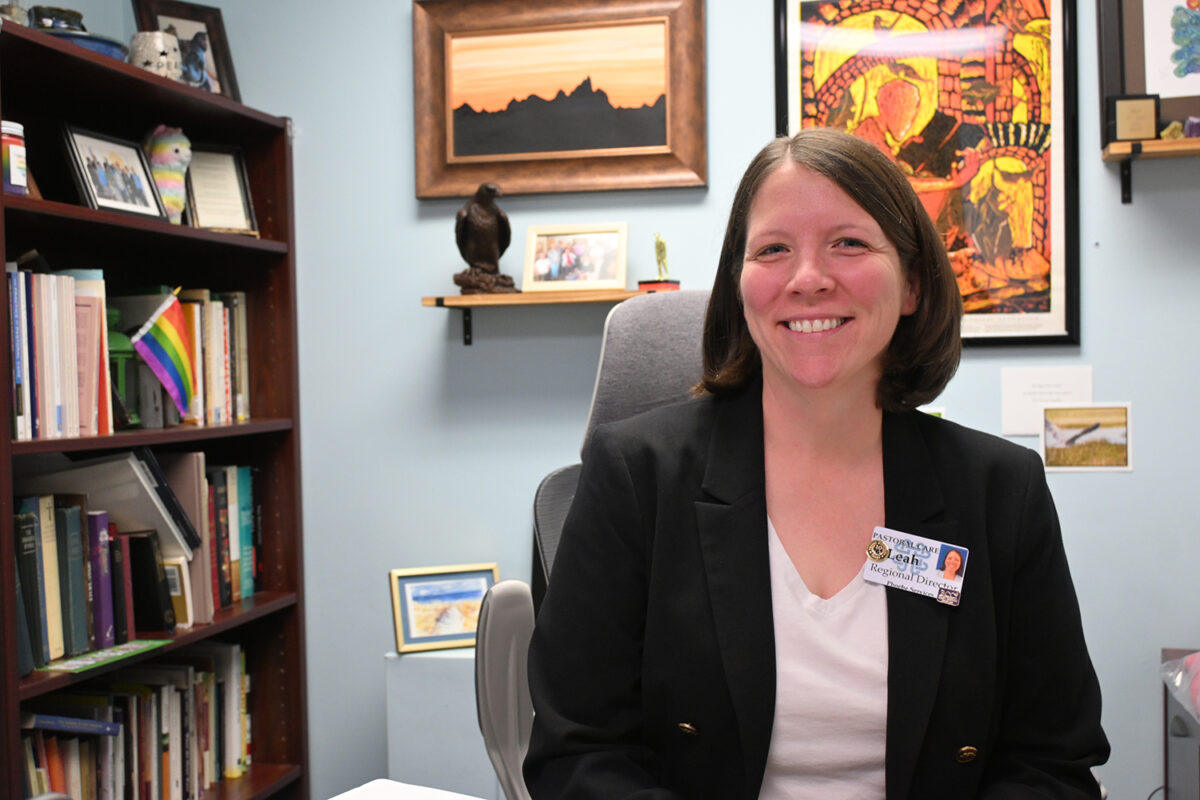
In her own words, this is one of the guiding philosophies that Reverend Leah Knox, Director of Pastoral Care and Education, employs in her approach to Clinical Pastoral Education (CPE), a training program for spiritual care professionals. It’s a field that she holds an immense passion for, partially fueled by her own journey of self-discovery, acceptance, and curiosity.
Knox was born and raised in Tennessee, where she lived for 28 years. To this day, she feels a deep connection to the state’s beautiful rural landscapes and southern hospitality.
Even more so than rural American landscapes, religion was always front and center in Knox’s life. She grew up the daughter of a Southern Baptist preacher and the youngest of her three siblings.
Knox spent countless hours of her life at church. She helped open the building, run the water for the baptismal pool, and lent a hand where she could to help keep the church operating efficiently. She attended Sunday morning church, Sunday school, and other regular church sessions. She also participated in church choirs, handbell ensembles, and Bible drills—the latter of which she credits her ability to recite Bible verses on a whim.
Despite being entrenched in this way of life, Knox never envisioned being ordained or working in ministry. This was mostly because the Southern Baptist Convention didn’t, and still doesn’t, ordain women.
Music was another early love for Knox. She sang gospel music at family reunions and would later land on the guitar after cycling through multiple instruments in her middle school’s band. After teaching herself to play, she performed in church gigs with a full band.
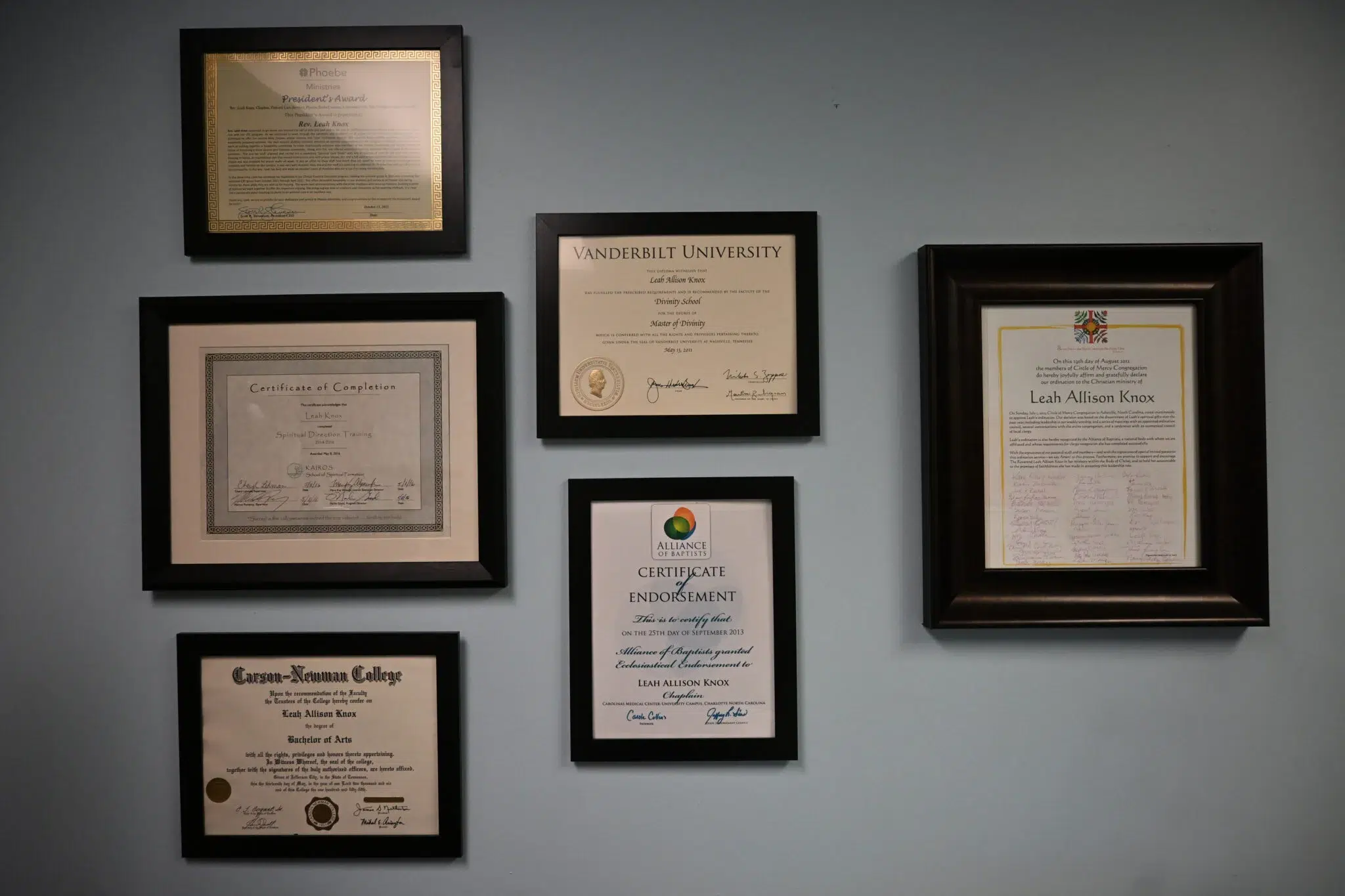
Knox’s higher education would begin at Carson-Newman University, a Baptist undergraduate college. Her general education courses required studies of scripture. She changed her major from journalism and communications and ended up double majoring in Philosophy and Religion.
“I was hardcore,” Knox laughs. “I took every class I could possibly take in that department.”
One aspect of college that was particularly enlightening to Knox was the learning model she was exposed to. She was often asked to interact with religious texts on a deeper level, treating them as more of a living document or something to have conversations with.
“It drew me in from the very beginning,” says Knox. “Some people saw it as a threat to their experience, but I was curious.” This new dimension of learning positively impacted her future role as an educator.
At Vanderbilt University, Knox earned her Master of Divinity. At this point, she was confident she wanted to explore the larger questions of life and religion. Vanderbilt also allowed Knox to branch out even further in her religious discovery and embrace new perspectives.
It was during her time at Vanderbilt that Knox had to face something that had been bubbling up inside her.
From a young age, Knox was only loosely aware of her sexuality. Due to her upbringing, she was forced to suppress those feelings both externally and internally.
“I was repressed enough that I didn’t fully embrace [that part of me],” says Knox. “I didn’t even go there within myself until Vanderbilt. I can look back and think, ‘Oh, obviously that’s what was happening,’ but I just did not allow myself to go there because it was too far out of the bounds of my upbringing.”
Even with that pressure looming overhead, Knox never felt the sense that she, or the queer people she knew, needed “saving.”
“I never questioned that I was loved by God or that something was wrong with me,” says Knox. “It was hard to make sense of that in my family relationships, but my connection with God? I was good.”
Knox hadn’t truly come to terms with her sexuality until she met her future wife, Brynn White. Knox decided six weeks after they started dating that it was time to come out to her family.
The fateful event came on New Year’s Day, 2010. Knox was 25 at the time. All her immediate family members were gathered in the living room when she decided to come out. The moment has stuck with her to this day.
“I was like, ‘I’m going to do this in one fell swoop,’” says Knox.
Knox can’t recall the exact words she used when coming out, but she knows the intense feelings that came over her before, during, and after the fact. The lead-up to the confession felt like the moment before a rollercoaster drop but multiplied by one thousand.
“I was so scared. I was just trembling and crying,” says Knox.
There was some relief within Knox after coming out, but between her distressed state and her family’s background, they suspected she was just “confused.”
“For a long time, my family did not know what to do with me,” says Knox. “I had those conversations of, ‘Here’s what the Bible says.’ There were years of awkward silence or stilted conversation and a very noticeable lack of curiosity about my life.”
In the years since then, the family has gone through some notable healing. Her siblings have begun their own spiritual journeys, ultimately accepting Knox for who she is.
As for Knox herself, she grappled with questions of faith, belonging, and tradition after coming out. Her openness around others became audience-dependent for some time as she carefully discerned who it was safe to be honest with.
Knox’s CPE training began shortly after graduating from Vanderbilt. In 2011, the couple trained in the Veterans’ Administration in Tennessee. They then moved to North Carolina in 2012, where Knox worked as a hospital chaplain. After two years, White’s work had the couple relocate to Pennsylvania.
Pennsylvania proved to be a whole new world for Knox, and the stark differences between Tennessee and their new home caused some culture shock. She recalls a moment when shopping at a local grocery store that made her realize just how much she missed that southern hospitality she had grown so used to: She performed a full grocery run without anyone making meaningful conversation with her.
“It was heartbreaking,” says Knox. “I got back into my car and had a moment,” she laughs.
The pace of life was also much faster in Pennsylvania than in Tennessee. It was a stressful change.
“Where it was scary to leave the south, it also meant freedom and much more opportunity,” says Knox. She notes that Pennsylvania has, historically, been more tolerant of LGBTQ+ people, which further helped her sense of pride.
Knox and White were living in a rental house in West Chester when Knox landed a job as a chaplain at Phoebe Berks in late 2014. Meanwhile, White was hired at the Veterans’ Administration in Coatesville as their first female chaplain. The couple moved to Reading to split the distance between their two jobs. They also got married around this time, something they couldn’t do in North Carolina, where gay marriage was still illegal.
Leading up to her first phone interview for Phoebe, Knox made a promise to herself to be authentic, and that’s precisely what she did.
To her delight, Phoebe proved to be a place where Knox could feel at home.
“I felt respected. I don’t have to hide who I am in this role,” says Knox.
While working at Phoebe Berks, one of the biggest lessons that Knox learned was the importance of slowing down. She says that slowing down has been vital in connecting with the residents of Phoebe in order to relate to them better.
This lesson came through a random interaction while walking through the halls of Phoebe Berks. Knox passed by a resident who jumped at the comparatively fast speed Knox was moving. The resident politely remarked about how fast Leah was moving, flipping a switch in Knox’s mind.
“I scared her. That’s the opposite effect I want to have on someone as a chaplain,” says Knox. Life in Pennsylvania had taught her to speed up, but Phoebe helped her see the importance of doing the opposite.
The road to achieving her current role as Director of Pastoral Care and Education was long and arduous. Between encouragement from Rev. Dr. Scott Brooks Cope, former Regional Director of Pastoral Care and Education at Phoebe, and her own passion for CPE, though, it wasn’t a question of whether or not she would pursue this line of work.
After years of education, tests, presentations, essays, and paperwork, Knox is finally wrapping up her certification from the Association for Clinical Pastoral Education in 2025.
Knox quickly fell in love with teaching, which has fueled her drive to make her classes the best they can be. She refuses to continue the destructive cycles of the past.
Knox’s classes emphasize a welcoming environment and an openness to learning. If a student is unwilling to participate in meaningful conversation, CPE simply isn’t right for them.
To enhance the education of the group, Knox makes it a point to incorporate as many different perspectives as possible when approaching philosophical, moral, and religious questions. CPE has no particular religious affiliation.
“We are here to accompany people, sometimes in the hardest parts of their lives,” explains Knox. For her students to be equipped with the strategies to address the struggles of said individuals, diversity has become vital.
“I feel very strongly about CPE because of how transformative it was for me,” says Knox. “When you’re willing to be reflective, you’re more honest with yourself.”
Knox is the first woman and lesbian in her current role, a title she holds with great honor.
“Our world needs gentleness. It feels like you have to display strength constantly. But gentleness actually requires a lot of strength,” says Knox. It’s a mantra she embodies through her work, and it’s her vision for a better world that we can all learn from.
On behalf of Phoebe Ministries, Happy Pride Month.
To learn more about Clinical Pastoral Education, please visit phoebe.org/clinical-pastoral-education.
Written by Dominic Trabosci